
Beyond The Basics: A Master Tech’s Deep Dive Into RVTI’s Curriculum
RV Technical Institute’s Level 4 technicians have completed all five designated Level 3 specialties through vendor training. They are proficient in troubleshooting and repairing the seven major systems and components within an RV (propane, electrical, water, appliances, generators, chassis, and body).
Robert Anthony, founder of mobile technician business Rob the RV Guy, recently became a Level 4 Master Certified Technician. Based in Coeur D’Alene, ID, and Spokane, WA, during summers and central Florida during winters, Robert provides troubleshooting, system upgrades, or custom solar solutions to enhance off-grid capabilities. His business also conducts maintenance, solar installations, and tank cleaning.
Launching Rob the RV Guy inspired him to seek out training opportunities. “I wanted more RV technician education when I started my business,” he explained. After a couple of friends recommended the RV Technical Institute, Robert began to research the organization. “I learned that the RV Technical Institute is industry-recognized and supported by the RV Industry Association and the dealers,” he recalls. “And then a Truma event opened up that I was very interested in, and it happened to coincide with the RV Technical Institute’s trainings.”
“So, I decided I would complete Level 1 virtually in anticipation of the Truma course (a three-day in-house training that covered all five of Truma’s product lines), and then complete RVTI’s Level 2, since I would already be in Elkhart, IN,” he continues. “Everything lined up and pushed me in that direction.”
For Robert, one of RVTI’s highlights was the instructor: “I thought that Trainer Tyson Watkins did a good job. He has a lot of industry background; he's worked for dealerships and manufacturers, and he’s been his own boss. So, Tyson brought a lot of experience to the table.”
When considering his Level 3 experience specifically, Robert particularly enjoyed the chassis and slide-out specialties, which were taught by Lippert. For technicians who have completed the Level 1 and Level 2 trainings, Level 3 training offers supplier training on specific types of components. Level 3 training leads to increased skill sets where technicians can perform advanced diagnostics, troubleshooting, and repairs on those systems and components.
Robert has a few recommendations for technicians who are considering attending the RVTI program, “I liked the way that Lippert worked with the RV Technical Institute. They covered everything you needed for the RV Technical Institute’s slide-outs and chassis specialties, and the organization was extraordinary,” he states. “If people are going to sign up for Level 3, I recommend signing up for the slide-out and chassis specialty courses taught by Lippert.”
Robert also recommends that technicians attend as many in-person courses as possible to gain experience, including those taught by other companies in the RV industry. “I went to the Truma course, which gave me 16 Continuing Education Credits for appliances. And Dometic held a three-day training in Jacksonville, FL, that educated you on their product. We were diagnosing and troubleshooting water heaters, furnaces, and air conditioners that they brought. In three days at Truma, and in three days at Dometic, I had all the Continuing Education Credits I needed for my appliance specialty.”
“For those who want to take Level 3, I recommend looking at the opportunities that the vendors are providing and trying to attend one of those,” he continues. “You receive more hands-on education opportunities. Training on-site at the factory, or vendor, or manufacturer is the way to go.”
When considering how his experience with the RV Technical Institute has enhanced his mobile technician business, Robert remarks, “It has given me a little more self-confidence in the field. I've always had a mechanical acuity, so that is something that comes naturally to me. It did enrich what I've learned. It’s elevated my ability to serve customers by teaching me where to look to solve the problem. Additionally, I made some good connections there. There's a network of reliable people that I can call if I get stuck on an issue. All of this ultimately translates into a better service for customers.”
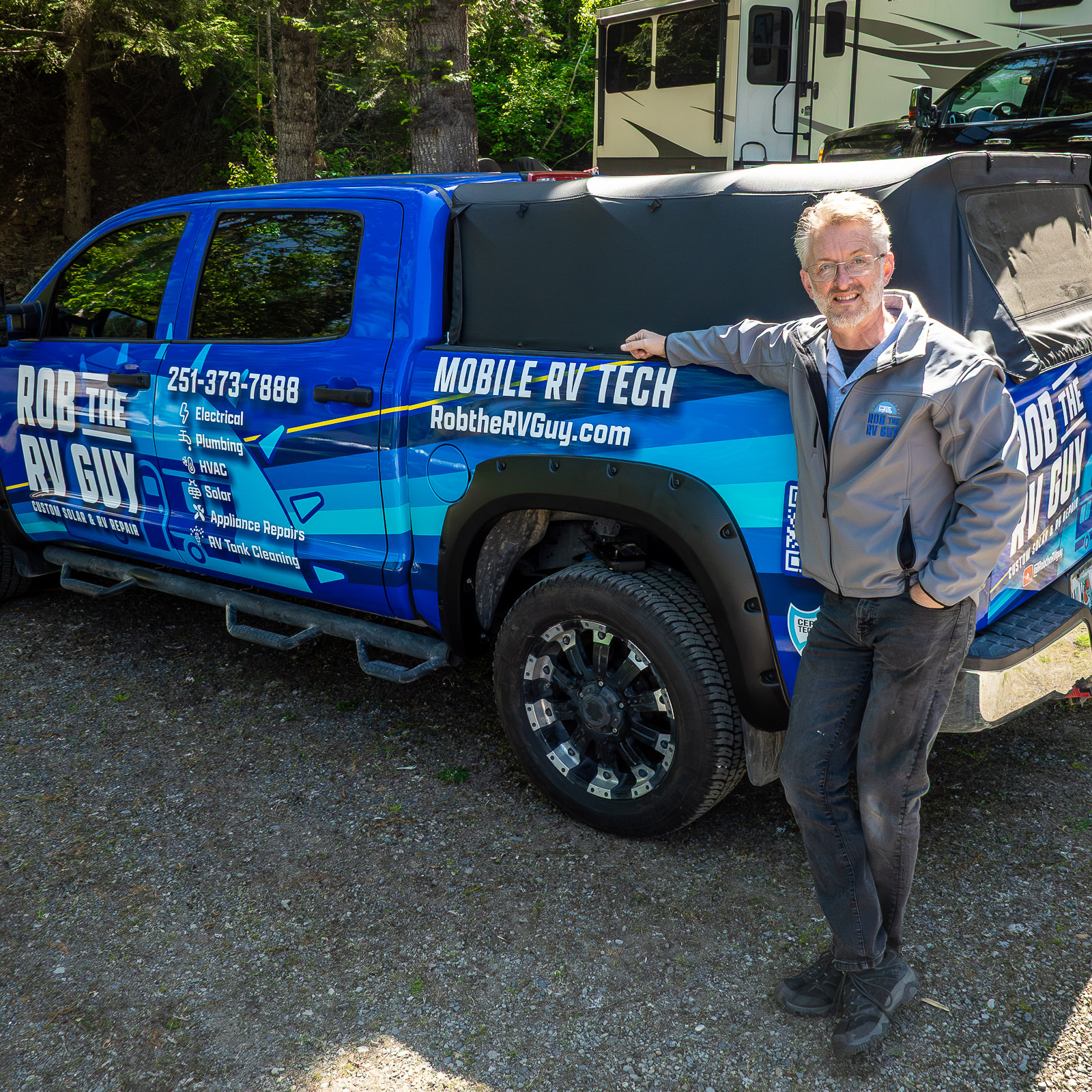
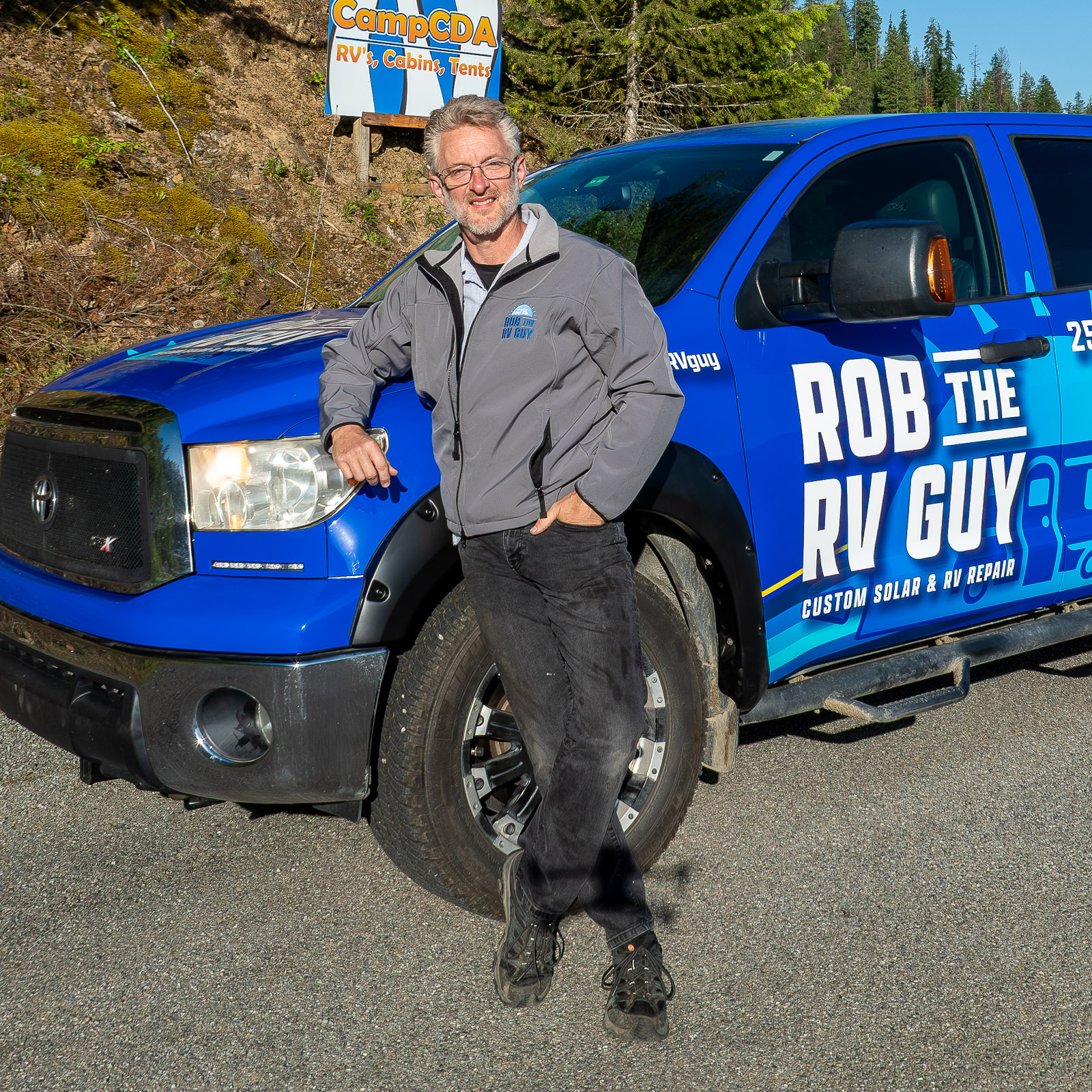
Robert and his family work together to make the mobile technician business successful. His wife is the receptionist, while Robert and his sons perform mobile technician duties. “We take this very professionally. My Toyota Tundra is wrapped; it's the talk of everywhere I go because it screams that we're serious about this. We wear uniforms. I spent 38 years in retail, so we understand customer service. We market very heavily. We are good with our website. We run this business with real effort and coordination.”
His sons, Levi and Jake, have their own mobile technician businesses, with brands similar to their father's: Levi the RV Guy and Jake the RV Guy, respectively. “The brand is consistent with high-quality service, responsiveness, and extreme professionalism,” explains Robert. “We're getting our systems in place with our customer flow, our funnel, fulfilling service requests from customers, and then following up afterward to make sure everything's alright. We feel that we've got a really good system.”
He adds that, now that his business has established its scheduling, accounting, marketing, and brand, they are considering turning it into a franchise— with RVTI training as a requirement: “We’re going to start considering what that would look like. And, for technicians who join the franchise, part of their requirement would be to attend RVTI through Level 2. I would also want them to have the Level 3 appliance and electrical specialties, at a minimum. I think the RV Technical Institute would give techs the basis that they need."
Robert adds that he loves being a mobile technician: “I never envisioned that this would be my life. This is something that can keep you busy all year long, and it's great. I just love it.”
“I think attending the RV Technical Institute was a good opportunity for me,” Robert concludes. “I don't regret this training one bit. I'm glad that I got to spend the time in Elkhart, IN. I was able to go on some factory tours, and that was really nice, too. Tyson encouraged that and organized one or two of them, which was nice. Attending RVTI was an inexpensive investment that was worth every penny.”
Please Sign in to View
Log in to view member-only content.
If you believe you are receiving this message in error contact us at memberservices@rvia.org.